
What is graphic recording?
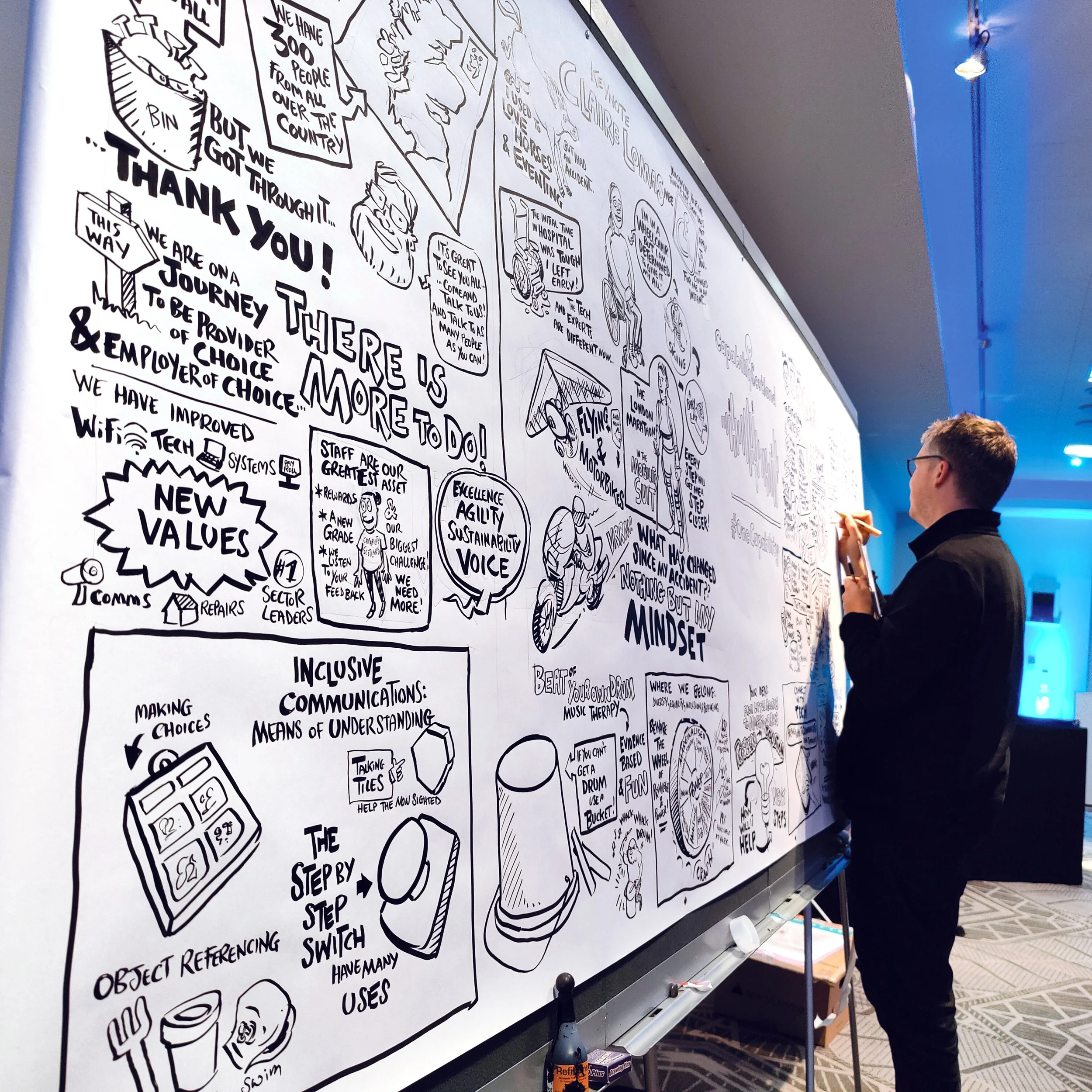
I call myself a ‘Graphic Recorder’ but my role can also be described as a live scribe, a live illustrator or simply a cartoonist. Whatever you want to call it, I've been doing it for more than ten years.
As a Graphic Recorder, I draw what people are talking about as an event unfolds. I combine words and images, arranging them spatially as the conversation is happening, in real-time.
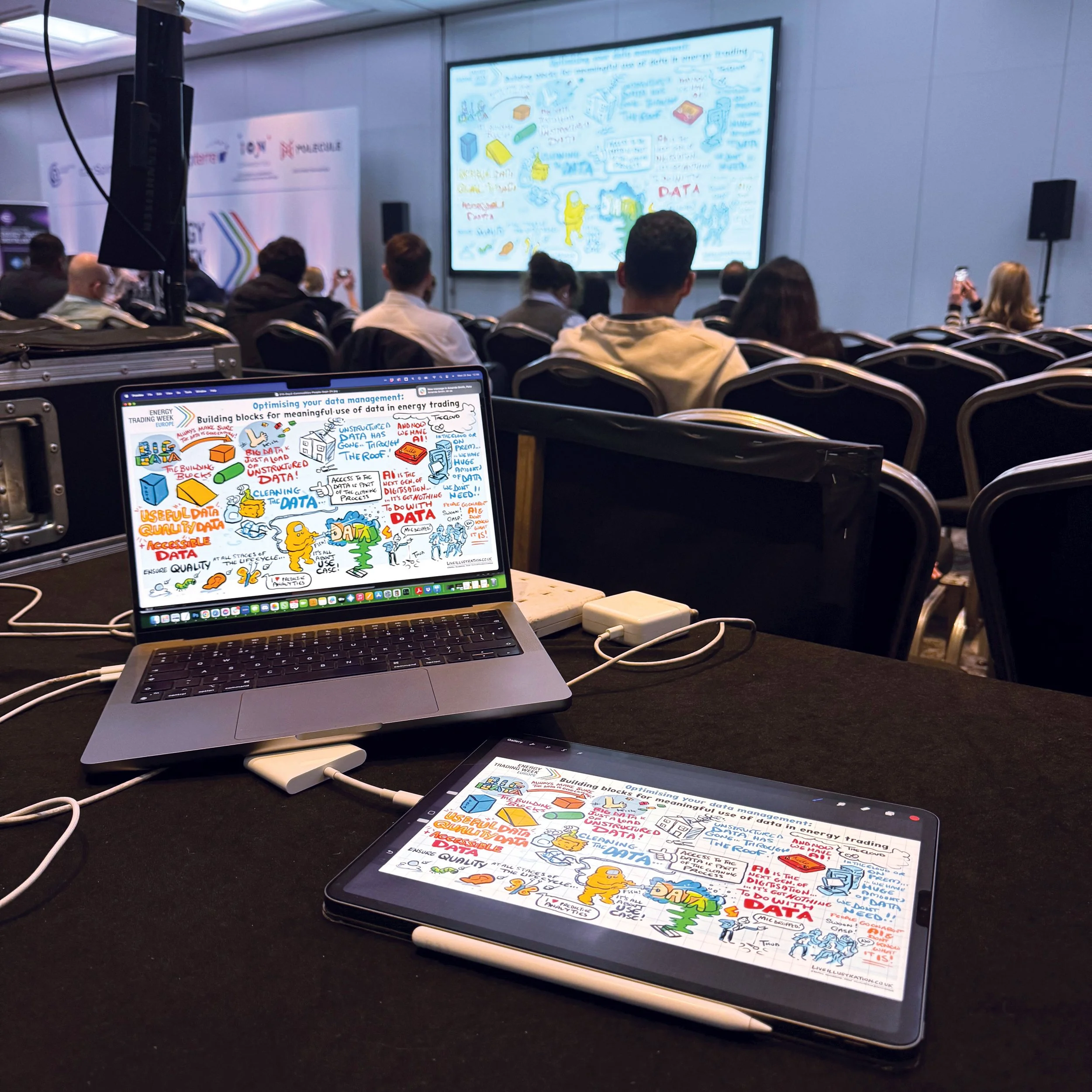
This work can be quite diagrammatic, or it can be very visual. It can happen slowly across a day, or quickly in hours or minutes. It can be done in person on large pieces of paper, digitally on iPads or remotely on video calls.
At the core of this practice is synthesising the event into a visual record as it happens to engage the audience and provide a memory of the event.

So what does a graphic recorder actually do?
The person who does this work is called a ‘Graphic Recorder’. But they can also be described as a live scribe, a live illustrator or simply a cartoonist. But they have a complex task. Graphic recording requires intense listening to a speaker at an event, a discussion in a meeting or the progress of a workshop. They must be able to recognise, surface and prioritise the most important information in those moments.
As this happens a graphic recorder will rapidly put this down on paper. Capturing the information in these environments is a huge benefit to the audience and participants. And that is why it is done live in front of an audience. This requires speed and accuracy in the note-taking.
In addition the artist can add illustrations, images and diagrams to create a fun and engaging image that not only entertains the audience but actually helps the cognitive process. Connecting images and words together aids the memory.

Why do businesses use Graphic Recording
Graphic Recording has grown from the art of Graphic Facilitation, a way of running meetings that engages participants and gets better results from them. A real-time visualisation of a meeting or event can bring a session to life, aid decision making, inspire ideas and promote understanding.
Important meetings, conferences and workshops can lack engagement. Having someone in the room actively supporting the meeting through visuals helps people get to grips with challenging ideas, remember key points and build on them.
Having a highly illustrated diagram of a meeting is a great way to make it unforgettable, much more than 'just another meeting'. A visual documentation of the event makes a powerful post-event business tool to promote further conversations, whatever the subject.
Sitting alongside the client's presenters, AV teams, lighting, sound and videography people, a Graphic Recorder becomes a core part of a conference's run of show. Holding a similar position to a keynote speaker, they provide a visible stream of information presented in a compelling, attention grabbing way.
Businesses find this adds value to meetings and events, making the maximum impact on attendees. As the costs of meetings rise, it's a good way to maximise the return on your investment.
Where do we see Graphic Recording used the most?
Graphic Recording is used in every sort of conference, workshop and meeting.
Conferences use Graphic Recording experts to visualise talks and sessions. These drawings, when done on large pieces of paper or via sophisticated AV systems digitally, are a crucial element to entertain and inspire people, adding spice.
In a more intimate workshop setting a Graphic Recorder also provides a continuous flow of images and words, this time in support of a facilitated process. At this point Graphic Facilitation and Graphic Recording can work seamlessly together, combining in a tangible, meaningful way to keep everyone focused, on track and performing well. You can imagine how a visual record of progress emerging throughout the day becomes a key pillar of a successfully facilitated workshop.
Some meetings are smaller than conferences but not as interactive as workshops. There's still a role for the Graphic Recorder. Maybe you're holding an annual kick-off meeting, a launch strategy, or checking on the progress of your goals. When you combine a highly presentational approach with fluid, interactive graphics, the dramatic visualisations and images falling out of the process have a powerful impact.
Imagine a hand-drawn version of the company's strategy, created on-the-go in front of key stakeholders. It's a much better takeaway than a Powerpoint presentation. While complex, fast-moving real time visualisation tests a Graphic Recorder's abilities, it is what we do best.

What is the difference between Graphic Recording and Graphic Facilitation?
Best operating in a team to support each other, Graphic Facilitators and Graphic Recorders often work together. The Facilitator runs the meeting (and doesn't do very much drawing) and the Recorder will be drawing a lot. It helps if they can swap roles, since part of the Graphic Facilitation process involves confidently drawing diagrams and shapes. Depending on circumstances, a Graphic Recorder will need to speak confidently to teams and groups, making sure the right insights are foregrounded, voices heard and images created.
Critically, Graphic Facilitation is a creative way to design and deliver meetings and workshops while Graphic Recording can adapt to many more environments, being mainly about live visualisation. If you're not sure which you need, we'll advise you.

Do you have to be able to draw to be a Graphic Recorder
and what else do you need to do?
The real truth of the matter is no, you don't need to be able to draw to be a graphic recorder. But it does help. Drawing a wide range of images in my own style, incredibly fast, lets me create graphic recordings that stand the test of time and have a real impact.
If you just need to get the job done, visuals made up of of boxes, arrows, lines and so on will work. But you'll still need to articulate a visual language in a meaningful way, and do it in front of a room of people looking at you.
A Graphic Recorder's core skills
There's more to it than creative talent. Graphic Recorders are also businesslike. We adapt to any event, exploring the schedule and confirming what can and can't be drawn. We will always make it clear to the audience why we are there, what we will do, and what we won't do. We have great listening skills and know intuitively how to pick out an event's key themes.
We engage on a deep level with the subject matter of the meeting or event, and we're confident and fluid in drawing, writing and making on-the-fly editorial decisions in front of an audience. We don't visualise everything everyone says, we never run out of space before the end, and we understand that good materials – and a well-lit space - make all the difference.
Top tips for graphic recording:
Make sure you can listen carefully and pick out key themes
Be ready to engage on a deep level with the subject matter of the meeting or event
Be confident in drawing, writing and making on the fly editorial decisions in front of an audience
You do not have to visualise everything everyone says
Don’t run out of space before the end
Good materials make all the difference
Make sure people know why you are there, what will you will do and what you wont
Makes sure you have good light - you need to be able to see
Graphic Recording FAQs
Q: Should I book a Graphic Recorder early to avoid disappointment?
A: As events professionals know, some times of year are a lot busier than others so it's better safe than sorry to book in good time.
Q: What equipment does a Graphic Recorder use?
A: Our equipment varies from large drawing boards through to a simple table and plug for an iPad. It all depends on the unique qualities of the event.
Q: Do we need to see the presentations beforehand?
A: There's usually no need to send over an entire Powerpoint presentation. If yours is going to be unusually complex, for example a Strategy presentation or CEO briefing, it helps if we can preview it to pick out the key themes. A schedule, agenda and insight into any particularly important information also helps the artist get familiar with your organisation, decide what to draw, and pin down how much time to devote to each element.
Q: Can you draw live digitally?
A: Yes, it's a core part of what we do. We've mastered the fine art of illustrating video calls as well as in-person events. Sometimes a big board or bit of paper is a much better fit than digital. It's all about what's best for the audience.
Q: Will you sign an NDA?
A: Of course. You can rely on us to be discreet and professional, working to Chatham House rules.
Q: Can we keep the drawing afterwards?
A: Yes. If we draw on paper, it's yours. We also digitise our work to a high print quality then send it to you after the event.
Q: Do you travel?
A: We travel the world for Graphic Recording, but you might be able to find a good local provider.
Q: How to build Graphic Recording into an event?
A: Please include time for the audience to look at our work, making it a formal part of the event schedule. Remember you'll need room for the Recorder's drawing board, and a place for an iPad to be plugged in. Also make a plan for post-event distribution, the perfect opportunity to re-engage with audiences – maybe print the drawing out or turn it into a flip book to hand out.
Q: So how do we kick things off?
A: Your Graphic Recording artist will introduce themselves with a one-liner so everyone knows why they're there and what they'll be doing.
Q: What do we know about your business?
A: As Graphic Recording artists our work gives us a surprisingly deep insight into all sorts of sectors. We can work for a pharmaceutical company one day, a fintech player the next, which means we have a broad perspective on the way the business world works.
Q: Can you provide examples of graphic recording projects?
A: Yes! We've visualised breakout sessions for a major law firm's new vision, and effective patient journeys through live interviews in the healthcare sector. We have digitally captured a CEO's new strategy presentation to staff, live, in a prearranged sequence. We loved gathering insights from a group of school children, drawn up later then presented to visiting politicians, and it has been amazing creating a crowd sourced mural with industry professionals in the marketplace area of a conference. We've even captured 12 speaker sessions digitally during an all-day event, for immediate social media distribution.
Top tips for event bookers:
Schedule, agenda and important information:
Prior to an event all of this information will help the artist know what to draw, how much time to devote to each element and allow themselves to become familiar with your organisation.Build the graphic recording into your event:
Allow time for the audience to look at the work as part of the schedule, be it digitally on the screens or in the coffee breakMake space for the graphic recorder:
Believe it or not but organisers can forget this. A drawing board will need space in the room to be set up, an AV team will need to budge up and provide a chair next to their mix desk so an iPad can be plugged in.Tell the audience they are here:
Without a proper introduction the graphic recording artists producing artwork will confuse the audience. A simple one line intro at the start of the event makes such a difference! It’s incredible how often this is overlooked.Make a plan for post event distribution:
This kind of work is always popular with audiences and the question you will be asked over and over again is ‘can we get a copy of the drawings’. They make a great way to re-engage with audiences post event and can even be printed or turned into flip books as an extra level of ‘take away’.

Who uses Graphic Recording?
The answer to this question is simply - everyone can use it! This work can be done in any business area. The scribes who create graphic recordings are used to working for a pharmaceutical company one day and a fintech the next. This makes these artists a particularly valuable source of expertise as they often have a very broad perspective of multiple industries. Every event is different but here are some key scenarios a Graphic Recorder can find themselves at work, based on recent examples:
Visualising breakout sessions for a new vision for a major law firm
Creating patient journeys from live interviews for the healthcare sector
Digitally capturing a new strategy presentation from a CEO to their staff live in a prearranged sequence
Gathering insights from a group of school children to be drawn up and presented to visiting politicians
Creating a crowd sourced mural from industry professionals in the marketplace area of a conference
Capturing 12 speaker sessions digitally from an all day event for immediate social media distribution
TL:DR
If you are having an event bringing a Graphic recorder to it is essential if you want it to be memorable, engaging and creative.
Find out more with these links…
David Sibbet Find out more from David Sibbet, the godfather of Graphic Recording, whose many excellent books include Visual Teams
Loosetooth - Visit the Loosetooth website by Brandy Agerbeck, whose book The Graphic Facilitators guide is an excellent starting point for wannabe Graphic Recorders
World Café - The Old World Café website is one of the first formal, integrated uses of Graphic Recording in a Graphically Facilitated process
The Graphic Facilitation Facebook Group The Graphic Facilitation Facebook Group is where you can meet local and international practitioners at every level. Or visit the International forum for Visual Practitioners
Finally Gamestorming is my favourite book and the place that I first discovered the concept of Graphic Recording via Sunni Brown
And while it’s not ‘Graphic Recording’ specifically I got my first big break at an unconference - the best conference format
Drop me a line..
If you'd like to know more about what I can do for you, or ask a question, fill in this form and I'll get right back to you.